A brush holder needs to do more than contain your handles when you arrange them for a picture. You should be able to recognize the brush you want, lift it without dragging several others along, and return it without pushing its head against the rim or a neighboring tool.
Begin with a few clean, dry brushes and a holder you already own that is appropriate for the job. This is a fit and access exercise, not a test of hygiene or product protection, and an attractive arrangement does not establish that a container is suitable for every kind of brush.
Measure the tools you actually use
Put your daily brushes beside one another and identify the longest handle, the shortest complete tool, and the widest head. Those three items may be different brushes, so a single average length will not tell you whether the holder works for your real collection or merely for one convenient example.
Measure the full tool rather than the handle alone, and note where you can comfortably grasp it without touching the head. A short brush that disappears below a tall rim may technically fit inside the holder while remaining difficult to recognize and retrieve during an ordinary getting-ready routine.
Keep double-ended tools separate while you make this first assessment because they do not have a plain handle end that can rest on the bottom. Their needs may lead you toward a horizontal resting arrangement instead of forcing every brush into the same upright container for the sake of visual consistency.
Find the holder’s usable measurements
Record the holder’s internal depth, the usable opening, and any dividers that reduce the available space. If you only have a manufacturer’s external dimensions, treat them as a first outline rather than a promise that the same width and depth are clear inside the container.
For example, MUJI lists its named polypropylene makeup box at 5.9 by 8.7 by 6.7 inches and says the lid is sold separately. That is useful product information, but it does not describe every possible brush arrangement, the clear height under another lid, or the internal fit of a different box in the same series.
Ask the seller for the missing internal measurement if it is essential to your choice. A ruler in a styled photograph can be difficult to interpret, and a general description such as “large brush organizer” does not tell you whether your shortest everyday brush will remain accessible.

Check the shortest brush first
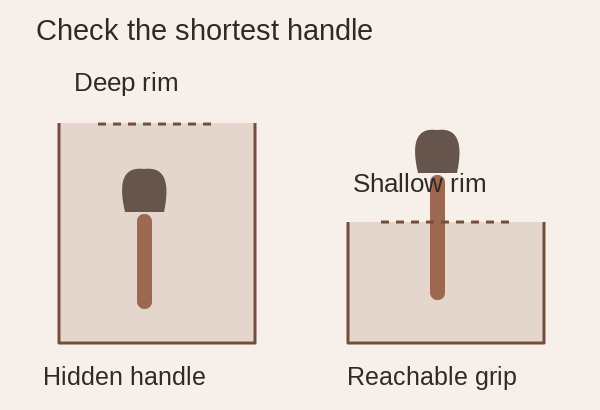
Place the shortest tool in the empty holder and see whether enough of its handle remains available to lift it normally. You should not need to tip a container full of other brushes every time you want one small finishing tool, especially on a table with open makeup nearby.
Then add the longest brush and look at the difference between them from your usual seated or standing position. If the shorter one becomes hidden, consider a separate shallow compartment rather than packing material into the bottom without knowing whether that addition is appropriate for the holder and tools.
A small removable cup may create a useful section, but include the cup’s own wall thickness and stability in the arrangement. Do not assume that adding a divider always increases useful capacity; sometimes it simply turns one broad opening into several narrow spaces that no longer accept the tools comfortably.
Leave room around the heads
Add the widest brush next and notice where its head sits relative to the rim and the surrounding brushes. A holder can have enough room for the handles while causing the heads to press together, so look at the complete tool rather than counting how many handles you can fit into a circle.
Try lifting that broad brush and returning it while the other tools remain in place. If you need to push aside several heads with your fingers, reduce the number stored together or move the broad tool to another suitable location before assuming a larger decorative container is the only answer.
Keep the holder’s edges and seams in the assessment as well. A tool that catches when you remove it may need a different position or a different container, and a gentle-looking photograph does not establish that the actual rim is suitable for repeated contact with your brush.
Check the complete surface arrangement
Set the holder where you intend to use it and include its base in the footprint. A tall container near the edge of a small table may interfere with your ordinary reach to a mirror or compact even when the brushes themselves fit inside it without trouble.
Try the getting-ready movements with closed products first, keeping the surface stable and the holder away from an edge where you might knock it. If you share the table, check whether the container can move to its storage place without carrying several loose objects around it at the same time.
A holder that remains on the counter and a holder you move after every use have different practical demands. Include the return journey in your trial, and do not treat a heavy or broad base as automatically better when it makes the actual storage location difficult to reach or use.
Keep storage and care instructions distinct
Find the holder’s material and its care directions, then compare them with the instructions for your individual brushes. A container that can be wiped with one product does not establish that the same cleaner belongs on the brush handle, ferrule, or bristles, and a brush cleaner may not be suitable for the holder.
Only return tools when they are ready for the storage method you have chosen and their instructions allow it. If a brush is still in its care or drying stage, give that stage an appropriate place rather than treating an upright display holder as a universal drying solution.
Keep loose fillers out of your default plan unless you can establish that they are appropriate for the actual arrangement. Their appearance is not evidence of stability, cleanability, or compatibility, and you can often solve a height problem more directly with a shallower compartment or fewer tools.
Write a fit note before shopping
Finish with the specific limitation you found, such as “the short finishing brush sits below the rim” or “the broad powder head blocks the smaller tools.” That tells you what a replacement needs to improve and keeps a shopping search from turning into an unrelated hunt for a larger matching set.
For a fictional kit of four tools, you might keep three longer brushes in the upright holder and one short brush in a shallow nearby tray. That can be a complete practical solution even if it does not produce one uniform display, because each tool remains recognizable and accessible for its actual job.
Recheck the arrangement when you change tools, add a protective sleeve, or move the getting-ready station. A holder is useful when it supports your current kit and ordinary movements, not because it promises a particular brush count that may have been based on tools unlike the ones you own.
Keep your measurements with the model name of any holder you compare, including whether a listed height is internal or external. That small distinction can save you from repeating the same fit question when a new color, lid option, or similar-looking size appears in the shopping results.
Keep the shortest and widest tools in the fit note together, because solving one problem can create another. A shallower holder may expose the short handle while leaving a long brush less conveniently supported, so check the complete selected group again before calling the arrangement finished.
 THE TOOL EDIT
 THE TOOL EDIT
